QRAD
A reporting system for radiation dose and examination activity, built for radiology units, hospitals and medical imaging centers.
Request a quote- Sector
- Healthcare
- Scope
- Examination dose reporting
The video is currently in production.
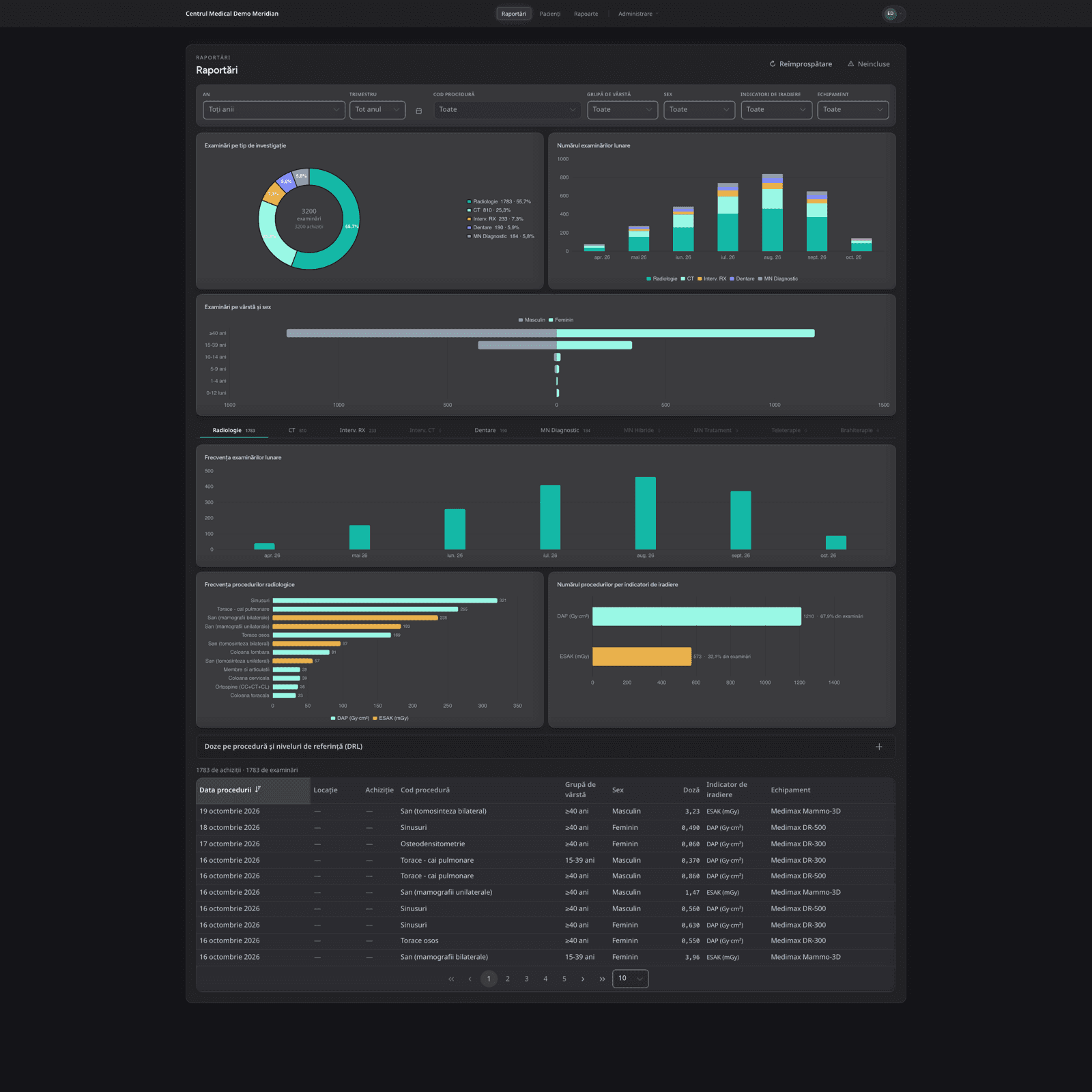
Dose data is recorded at every examination, yet answering a summary question ordinarily means aggregating it by hand. The system presents the unit's activity and patient exposure in a single view, structured by machine, type of investigation, procedure, age group and sex, and measured against the reference levels set out in the applicable regulations.
The data exists. The overall view has to be assembled by hand.
A radiology unit records dose data at every examination performed. The difficulty arises the moment a summary question has to be answered, such as the number of examinations in a given category and the average dose associated with them, and the answer means working through and totalling records by hand across an interval of some months.
The result is a process that consumes time, depends on the individual carrying it out, and is difficult to reproduce identically from one reporting cycle to the next.
By machine, by type of investigation, by procedure and by patient.
The overall view covers the total number of examinations and acquisitions, the distribution by type of investigation with each one's share, the month-by-month movement in activity, and the distribution by age group and sex, from infants to patients over forty. Each modality has a section of its own: radiology, computed tomography, interventional, dental, nuclear medicine, teletherapy and brachytherapy.
At procedure level it presents the frequency of each radiological procedure and the number of procedures under each irradiation indicator — dose area product, in Gy·cm², and entrance surface air kerma, in mGy — with each indicator's share of total examinations. A detailed table goes down to the individual examination.
Measured against the reference levels, quarter by quarter.
The average dose per procedure is compared with the reference levels set out in the applicable regulations, for each quarter. The comparison is what gives the data its practical value: an average figure does not, in itself, support a conclusion, whereas the same figure set against the reference level indicates whether an adjustment to the protocol is required.
The quarter is the unit of time for reporting. Movement from one quarter to the next allows the effect of any adjustment to be verified and documented.
Reproducible reporting, prepared for scrutiny.
Reporting is carried out on the same definitions and the same criteria at every cycle, independently of the individual preparing it. The time spent working through and totalling records by hand is eliminated, and the result remains consistent from one quarter to the next.
Filters on year, quarter, procedure code, age group, sex, irradiation indicator and equipment isolate any category in seconds, and records not included in the reporting are flagged separately, so that any gap is visible before it reaches a report.
Everything the system does.
- 01Total examinations and acquisitions across the unit
- 02Distribution of examinations by type of investigation, with percentage share
- 03Month-by-month movement in examinations, by type of investigation
- 04Distribution of examinations by age group and by sex
- 05Age groups from 0-12 months through to forty years and over
- 06A dedicated section for radiology, computed tomography and interventional
- 07A dedicated section for dental and nuclear medicine
- 08A dedicated section for teletherapy and brachytherapy
- 09Monthly examination frequency, for each modality
- 10Frequency of radiological procedures, for each procedure
- 11Procedure counts by irradiation indicator, DAP and ESAK
- 12Doses per procedure measured against the reference levels (DRL)
- 13A detailed table, one line per examination
- 14Filtering by year, quarter, procedure code, age group and sex
- 15Filtering by irradiation indicator and by equipment
- 16Records not included in the reporting, flagged separately
We build these for client organizations as well.
The products presented here began from the same two questions we put at the start of any project: which activities are still performed by hand today, and which of them ought to complete without intervention. Describe your situation and we will propose a concrete architecture.