ARIA
A digital receptionist for hotels, guesthouses and hotel groups that need front-desk requests handled outside staffed hours as well, in five languages, on a lobby touchscreen and by telephone.
Request a quote- Sector
- Hospitality
- Scope
- Voice-first hotel front desk
The video is currently in production.
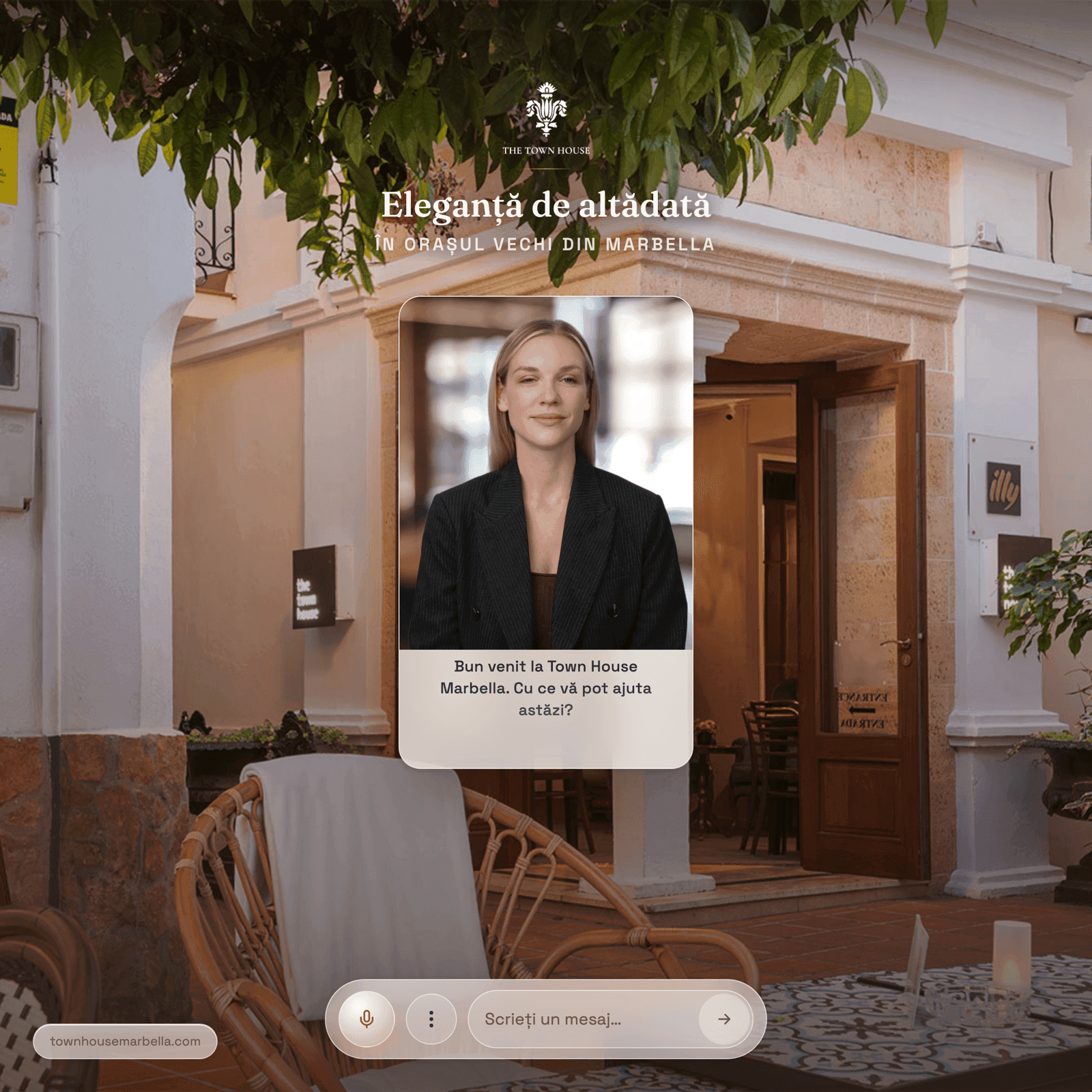
The front desk is a guest's first point of contact with the property and, equally, its principal point of queueing. The system holds the conversation with the guest, spoken or typed, on a touchscreen in the lobby, and carries through those front-desk operations the available integrations support, from check-in through to check-out, passing the rest to staff.
Front-desk availability is finite. Guest expectations are not.
Arrivals at a property are not distributed evenly across the day. There are peak periods, in which arrivals overlap and waiting time at the counter rises sharply, and there are overnight periods, in which the desk operates with reduced staff or is unattended. Both categories can be covered by increasing headcount; the difference lies in the permanent cost of an additional shift and in how rigid it is against a flow that varies from day to day.
Conventional self-service solutions transfer the effort to the guest, who must learn the interface, work through the forms in the order the application imposes, and locate the correct option within a menu structure that bears no resemblance to the way they would have put the request to a member of staff. Frequently the guest gives up, and the request reaches the desk regardless.
Seven front-desk flows, held in the guest's own language.
The guest states the request in their own words, spoken or typed, in Romanian, English, French, German or Spanish. The system recognizes what needs doing and works through the corresponding flow: check-in, direct booking, extension of the stay, check-out, room change, reporting a problem in the room, or a concierge request.
A guest arriving late enters the booking reference and surname, scans the identity document under optical character recognition, and receives an arrival card carrying the room, the access code and the wireless network details. Completing without an employee requires that the integration with the property's management system be available and that the document checks pass. The access code is read from the property's own systems, not generated by the application; where no usable code exists, the guest is directed to the front desk.
Property data and external services, explicitly delineated.
Information about the booking, the room, rates and the property's services comes from the hotel's systems. The concierge section rests on a points-of-interest index of its own, while the map and weather information are supplied by external services. The system is configured not to fill in by inference what it cannot find and not to offer approximations, and the transcription of the identity document passes a check-digit validation.
Escalation to the front desk is a designed function, not a failure mechanism: the system hands the request to a member of staff when it exceeds what it can resolve. Identification for later operations is by booking number or by room and surname; for guests who chose biometric enrolment on arrival, identification can also be by face. Biometric enrolment remains optional, and non-biometric alternatives remain available across every flow. Reception has a console of its own, with sections for occupancy, alerts, movements, activity and the property's settings.
Coverage outside staffed hours, five languages, predictable cost.
The property can take front-desk requests during the periods when the counter runs with reduced staff or is closed, within the limits of the available infrastructure and integrations. Existing employees are relieved of repetitive requests and can be assigned to the interactions that generate direct value: welcoming guests, promoting additional services and resolving complex situations.
Coverage in five languages eases communication with international guests from the first contact. A separate application, built on the same property data, also answers the telephone, so requests arriving outside office hours receive a reply. Direct bookings complete within the same conversation where online payment is enabled; otherwise completion stays with the front desk.
Key features.
- 01Check-in by conversation, from booking reference to arrival card
- 02Identity document scanning, under optical character recognition
- 03Optional biometric enrolment, with non-biometric identification alternatives
- 04Direct booking, from the property's real availability
- 05Extension of the guest's stay
- 06Check-out by conversation, with no visit to the counter
- 07Room change
- 08Reporting a problem in the room
- 09Concierge: own points of interest, map and weather from external services
- 10Identification by booking number, room and surname, or face
- 11Access code, read from the property's systems, and network details
- 12Spoken or typed interaction, on a lobby touchscreen
- 13Five languages: Romanian, English, French, German and Spanish
- 14A separate application answering telephone calls
- 15Reception console: occupancy, alerts, movements, activity and settings
- 16Escalation to an employee when a request exceeds the system
We build these for client organizations as well.
The products presented here began from the same two questions we put at the start of any project: which activities are still performed by hand today, and which of them ought to complete without intervention. Describe your situation and we will propose a concrete architecture.